What is task lighting?
Task lighting is localized lighting that provides the correct amount of focused light exactly where you need it which is a crucial part of an ergonomic workstation. The lighting is directed onto the desired surface to aid or relieve the eyes and therefore highlight the area you are working on. Some examples of specific task lighting applications are; reading, computer desk work, art and crafts station and cooking. Task lamps are products designed precisely for that purpose; often they are portable with a cord and plug.
Task lamps are made with LED bulbs that are less aggressive to our retinas and most task lamps tend to be adjustable. They allow users to position or adjust lights according to the needs of the user. Contrasting factors to consider with the efficiency of the task lamp is lamp position, lamp strength and the interaction between existing functional and ambient lighting.
Where do they sit in contemporary culture?
Task lighting plays an integral role;
- Light in Art and Culture – Museums, Art galleries etc.
- Use of daylight
- Gentle or Precise lighting (adjustable)
- Flexible colour temperatures
- Efficient energy saving methods
What is currently on the market?
Boalum
Designer – Livio Castiglioni and Gianfranco Frattini
“a snake of endless light” Domus
Its structure is a translucent flexible PVC, reinforced and with resin terminals make it virtually indestructible. It emits a diffused light and its timeless design makes it suitable for all environments. Thanks to its flexibility and unique form, it can be placed on the ground or on a table, hung or twisted to invent new forms every day. Delivered lumens output 780lm with 20W bulb.


Arrival
Designer – Ludovica and Roberto Paloma
Arrival is dynamic with flowing shapes that sculpt light with delicate graphic lines. Branching out from a central joint, each lamp has three arms that form a soft, organic geometric shape. Each element has a section that leaves the aluminium profile visible from the outside while generating a soft light-diffusing surface inside. Delivered lumens output 1869lm with 40W bulb.


Dalù
Designer – Vico Magistretti
This is a re-edition of the luminaire from the sixties designed by Vico Magistretti. It is available in various colours and finishes, though retaining its unmistakable original design. The lamp is composed of a body made of moulded thermoplastic material. Delivered lumens output 345lm with 28W bulb.

Fato
Designer – Gio Ponti
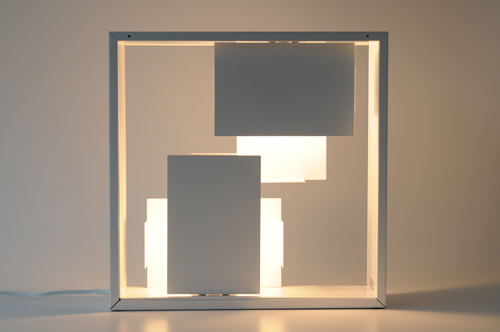
A table or wall lamp, with geometrical metal screens creating light and dark, screened and clear, all enclosed in a square frame. A lighting sculpture with a strong styling connotation to the ‘60s. Structure is in white enamelled, folded and welded plate. Delivered lumens output 730lm with 56W bulb.

La petit table
Designer – Quaglio Simonelli
Simple elements, combined into an amazing geometric composition. The lampshade is a lightweight plastic volume closed by two diffusers that produce a pleasant soft direct and indirect light. The joint connects the lampshade with the aluminium stem on a minimal support. Delivered lumens output 326lm with 6W bulb.


Talak
Designer – Neil Poulton
Talak has a stem structure, which allows movement around the axis and vertically along its height. The protruding top of body is modified to adjust, as well as to meet functional requirements for better use and relation with the working space. Delivered lumens output 745lm with 12W bulb.


Common Materials
Different materials perform better than others when used for different design purposes, considering factors such as chemistry and workability affect light play, texture, suspension and weight distribution.
- Glass – an aesthetic choice for task lamps, variable textures, tones, colours, and thickness to create light play and geometric shapes. Glass can be perfectly clear for direct lighting, semi-opaque for a warm glowing light, or opaque to produce a softer lighting effect.
- Metal – if not entirely produced out of metal most task lamps will consist of some metal components. Metal is a popular choice for its strength to weight ratio. With a variety of finishes and looks as well, such as brass, aluminium, copper or iron. They can be different in texture; smooth, polished, finished or coloured making it highly versatile.
- Acrylic – is modern, precise, lightweight, and highly pliable, which is why it’s popular material choice. Acrylic comes in many shapes, any sizes and colours. Quality acrylic offers a high modern look that is appealing to a mass consumer base.
- Fabric – adds texture along with light diffusion and shadow play. Fabric can offer a wide range of options for colours and patterns. Depending on how it’s used, another unexpectedly advantage of fabric is its ability to soften sound.
Image sources;https://www.deplain.com/en/artemide-boalum-floor-lamp.html, https://www.miliashop.com/en/table-lamps, https://www.stardust.com/artemide-dalu-table-lamp.html, https://www.utilitydesign.co.uk, https://www.velliniilluminazione.com.
 Eden Grace Design